
We all experience moments in life where we are more vulnerable to scams. These moments could include buying a home, being a victim of a natural disaster or coping with the loss of a loved one. During these moments, we may experience heightened stress and reduce our attention to risk. Unfortunately, criminals know this. Criminals can more effectively perpetrate payment scams when they deliberately target people when they are vulnerable, exploiting urgency, distraction and lowered skepticism.
This article, part of the series Understanding Scam Risk Across Customer Segments, explores scam risks impacting people at times of increased vulnerability and what financial institutions can do to protect their customers through timely education, outreach and support.
Stress Disrupts Decision Making
Stress can reduce the mental capacity we rely on for judgment, skepticism and attention to red flags (Off-site).
During stressful times:
- The brain shifts into rapid response mode, prioritizing urgency over analysis.
- Emotional load reduces working memory, making it harder to assess risk or notice inconsistencies.
- People become more likely to comply with authoritative or urgent-sounding requests.
- Quick decisions replace slower, more deliberate thinking.
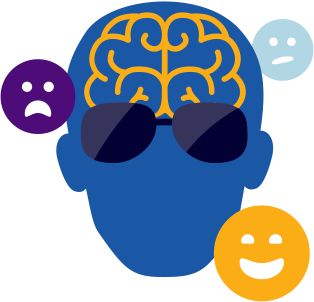
Criminals do not need to understand the science behind heightened stress to understand the effects. They know that someone juggling requests for a home closing or grieving for a family member may be more likely to follow instructions without pausing to verify authenticity.
Predictable Moments of Vulnerability
Major personal transitions can be emotionally charged, involve financial decisions and are often time-sensitive. In many of these situations, people are navigating unknown territory. This combination creates predictable moments for criminals. Some common events exploited by criminals may include:
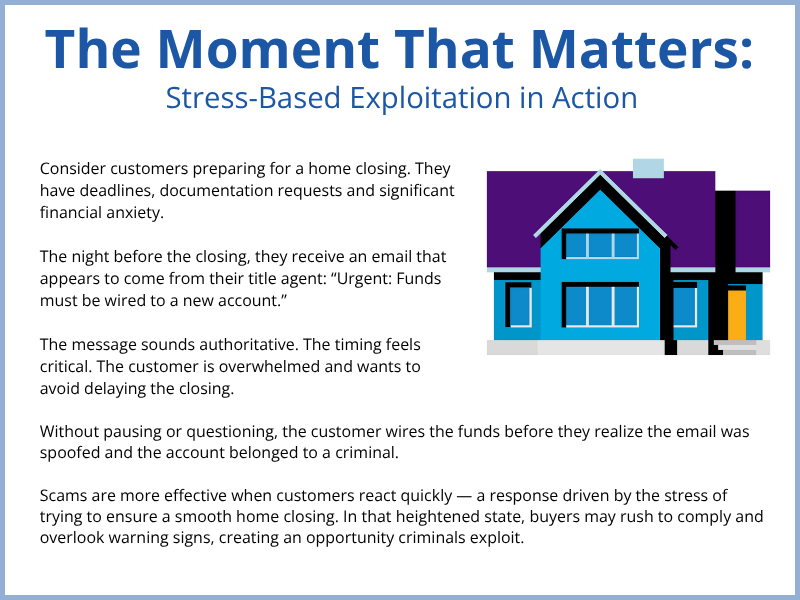
- Relocation or home ownership: Criminals impersonate real estate agents, title companies or lenders to reroute closing transaction payments.
- New adulthood: Young adults opening accounts or learning to manage money independently may be targeted through social media job scams, money mule recruitment (Off-site) or impersonation schemes.
- Catastrophic event: Criminals take advantage of emergency situations through impostor scams, falsely pretending to be a source of hope during a medical emergency, or posing as a charity during a natural disaster.
- Divorce: Criminals exploit emotional strain to develop a new relationship or impersonate legal representatives to obtain payments or sensitive information.
- Retirement: Criminals target recently retired individuals with investment scams and impostor schemes.
- Death of a loved one: Criminals monitor obituaries and target surviving family members with fake debt claims, benefit-processing schemes or romance scam attempts.
How Financial Institutions Can Help
Financial institutions can take practical, proactive steps to protect customers during moments of vulnerability. It starts with recognizing the moment, then delivering timely, relevant guidance.
Recognize Vulnerable Moments
Financial institutions often can identify when their customers are experiencing major life events. These signals can serve as early warnings that a customer might benefit from targeted support. Some indicators may include:
- Loan applications or large transfers associated with home purchases
- New account openings for young adults or new joint accounts
- Changes in authorized users, joint accounts or powers of attorney
- Notification of a death of an account holder or their loved one
- Sudden behavioral changes, such as increased customer confusion or urgency
Provide Proactive Outreach
When indicators suggest a customer is going through a life transition, institutions can send targeted educational messages that reinforce key red flags, such as:
- “Buying a home? Watch out for email‑based wire fraud and verify instructions by phone.”
- “Experiencing a major life change? Criminals often target people during transitions. Here are common red flags.”
- “If anyone pressures you to move money urgently, contact us before taking action.”
Messages are most effective when delivered at the moment they’re relevant, increasing the likelihood that customers will notice and remember them. When messages arrive outside the context of the actual event, customers are less likely to engage with or retain the information. It’s also important to help customers distinguish legitimate requests from fraudulent ones, and to set clear expectations for various life‑transition processes.
Pause and Review
Institutions can reduce scam successes by increasing monitoring during life‑transition periods and adding intentional friction when indicators of transition, behavior changes or scam red flags appear. These include:
- Alerts prompting the customer to confirm payment details using a trusted communication channel during large transfers
- Transaction delays for unusual or high‑risk payments
- Escalation to a live specialist trained in scam intervention
When designed with empathy and clear, nonjudgmental language, friction can become a safety feature rather than a barrier. Normalizing the experience, such as reminding customers that “these scams are very sophisticated, and many people are targeted during major life events,” can reduce shame and improve awareness. Additionally, follow‑up calls to potential victims can help identify ongoing scam attempts, build trust and provide continued support.
Conclusion: Strengthening Trust by Protecting Important Moments
Criminals deliberately target people during their most important and vulnerable moments. However, financial institutions often have visibility of these moments and can leverage their position as a trusted party to intervene. By recognizing stress-based vulnerability, proactively educating customers and designing processes that allow for a pause and review, institutions can stop scams before they occur and help customers navigate transitions safely.
The Federal Reserve continues to provide the payments industry with educational resources to help financial institutions combat payments fraud through stronger identification and prevention.
- Visit our Scams Mitigation Toolkit for more information on how to identify and prevent other types of scams.
- Learn how the ScamClassifierSM model can provide consistent and detailed classification, reporting, analysis, and identification of scams and related trends – which helps promote accuracy of scam reporting, detection and mitigation