
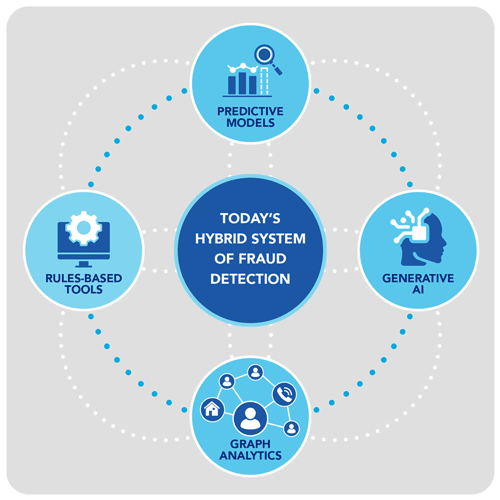
For years, fraud detection in financial services relied on static, rules‑based systems that essentially functioned as digital checklists, flagging activity that didn’t look “normal” or comply with predefined rules. Then, as fraud became more sophisticated, the industry shifted to predictive models, which use large sets of historical data to anticipate which transactions might be risky or fraudulent. From there, graph analytics have added an even deeper layer by mapping relationships between people, accounts and behaviors to uncover patterns that individual transactions alone could never reveal.
Recently, with the wide availability of generative AI, both defenders and criminals are beginning to use these tools in new ways. Attackers may use generative AI to:
- Craft more convincing scams
- Produce realistic fabricated identity documents
- Adapt their tactics to more quickly attack organizations
The same technology also can drive a significant evolution in defenses. Instead of simply spotting suspicious activity, defenders can use generative AI to:
- Understand context
- Summarize complex information
- Help humans and systems make faster, more informed decisions
These capabilities work alongside traditional rules‑based tools, predictive models and graph analytics, forming a hybrid system that combines the strengths of each approach to better protect customers and organizations.
Attacks Using Generative AI
Fraud risks have accelerated in both scale and sophistication as generative AI becomes more widely accessible to criminals. One of the most immediate challenges is the mass production of content. Generative AI makes it easy to create highly convincing phishing emails, scam messages, and social engineering scripts quickly and in multiple languages. This lowers the entry barrier for less skilled criminal actors by enabling them to launch attacks that previously required more technical expertise, coordination or language fluency.
Identity and access fraud may be evolving just as quickly. Generative AI technology can be used to generate synthetic identities that blend real and fabricated information in ways that are difficult to detect with traditional verification methods. It also enables the creation of forged documents and realistic deepfakes (video, voice or images) that can be used to bypass biometric checks (e.g. fingerprints, faces). These capabilities may compromise onboarding processes, digital identity systems, and physical authentication methods by overwhelming existing controls and enabling criminals to pass as trusted users during critical verification steps.
Business financial transactions also may become targets for generative AI-enabled manipulation. Attackers can generate fake invoices or fraudulent payment requests that mimic legitimate language and formatting. More advanced schemes can even simulate normal transaction behavior to slip undetected through risk‑scoring models, eroding the reliability of traditional anomaly‑detection methods and increasing the likelihood of unauthorized fund movement.
Fraud Detection Using Generative AI
While generative AI is actively used by criminals, the same technology also is being deployed to mitigate fraud. Financial institutions have been experimenting with generative AI in a variety of areas, from improving customer service to streamlining operations. But fraud detection and prevention are top priorities, according to recent research. A 2025 KPMG study (Off-site) found that 76% of surveyed institutions view fraud‑related use cases as their most valuable Generative AI opportunity. The Federal Reserve Financial Services’ 2026 Risk Officer Report (Off-site) identified AI image analysis and machine learning as solutions for detecting anomalies and mitigating check and ACH fraud losses.
While traditional systems have focused on fixed rules or patterns derived from past behavior, generative AI introduces a different level of capability. It can interpret and synthesize massive volumes of data, including structured data (e.g., defined transactions or lists) and unstructured data (e.g., freeform text, audio recording or images) and other data types to help bring clarity to suspect transactions where other risk signals are scattered or unclear. This can make it especially valuable in situations where analysts must make rapid decisions despite incomplete information.
Rather than replacing earlier rules‑based or predictive models, generative AI expands a financial institution’s toolkit. It may capture nuance, highlight contextual meaning, and explain why certain activities may need further attention. Generative AI may help teams understand not just what looks suspicious, but provide hypotheses of underlying reasons that make the behavior risky.
Use Cases in AI-Assisted Fraud Detection
As financial institutions explore how Generative AI can strengthen fraud programs, several use cases can be considered.

Model Training and Data Simulation
One promising area for exploration is model training and early‑stage analysis. Generative AI can provide synthetic data, or realistic, privacy‑safe examples of fraud activity, that allows risk management teams to train and test models without exposing sensitive customer information. It also can help uncover new or evolving fraud types by simulating scenarios and analyzing both structured data and unstructured sources, such as emails, case notes or documents. This can give teams a clearer picture of how fraud patterns may be changing over time.
Examples:
- Synthetic data generation can train models on realistic fraud scenarios without exposing personally identifiable information (PII).
- Fraud typology discovery can simulate and uncover new or evolving fraud patterns from structured and unstructured data sources.

Detection and Risk Scoring
Generative AI also enhances traditional detection and scoring methods. By interpreting context and language in real time, it can support more dynamic transaction risk scoring when paired with machine learning models. It can connect signals across different channels, such as online banking, phone interactions and text messages, helping institutions identify when separate events may be part of a coordinated fraud scheme.
Examples:
- Real-time transaction risk scoring dynamically adjusts risk scores using generative AI insights with traditional machine learning (ML) models.
- Cross-channel fraud correlation helps link fraud signals across multiple communication and transaction channels.

Identity and Threat Intelligence
In addition, identity verification and threat intelligence may benefit from generative AI tools, which can help improve detection of deepfakes, manipulated documents or synthetic identities. These tools may analyze message intent for signs of phishing or scams, using its language understanding to flag subtle social‑engineering cues that rules-based systems may miss.
Examples:
- Deepfake and synthetic identity detection can identify manipulated documents, voices or images in conjunction with traditional AI models.
- Phishing and scam message detection helps flag social engineering attempts using generative AI’s language understanding.

Analyst Enablement and Workflow Optimization
Finally, generative AI can be valuable across frontline fraud prevention operations, not just in back-office investigations. For example, call centers, can use it to analyze voiceprints alongside caller-provided information to help risk score interactions in real time, strengthening authentication even before an agent answers a call. On the investigative side, generative AI can summarize complex fraud events, extract key details from large datasets, or act as an intelligent assistant. From answering policy questions to prioritizing alerts by severity, it supports meaningful efficiency gains while easing analysts’ workloads, enabling experts to focus their time on the cases that matter most.
Examples:
- Reduce investigation time for fraud events by summarizing large datasets.
- Agentic assistants can assist fraud analysts with case investigations, queries and policy guidance.
- Alert prioritization can dynamically rank alerts by severity to reduce false positives and analyst fatigue.
What’s Next for Financial Institutions?
Given today’s challenging fraud landscape, financial institutions can benefit from exploring how generative AI can augment existing fraud detection tools and reduce investigation time.
This experimentation should be guided by a clear governance framework that addresses generative AI’s unique risks, including data privacy, model transparency, and potential misuse. Teams across fraud, operations, and customer‑facing roles most likely will need training on how to effectively and responsibly use generative AI tools, as well as to understand their strengths, and limitations. By investing in skills, layering defenses, and building thoughtful governance, financial institutions can explore generative AI in a way that enhances fraud prevention without compromising trust or safety.
Generative AI tools are unlikely to entirely replace existing fraud detection tools. Rather, they work alongside rules-based systems, predictive models, graph analytics and human expertise. This combined approach will be critical for building an effective defense against criminals’ evolving techniques and tactics.
Additional Resources
Account Takeover Fraud: A Persistent Threat
Stay Connected
Keep informed about the Fed’s efforts to support payment security and mitigate fraud by joining the FedPayments Improvement Community.
Glossary of Terms
- Model training teaches and refines an AI model to better identify and optimize patterns from large datasets, ultimately making more accurate predictions.
- Graph analytics evaluates relationships between data points, known as nodes, and their connections, termed edges.