
Fraud prevention has historically required a balance of speed and precision. Fraud and risk analysts need to quickly digest large volumes of data, recognize subtle signals and interpret patterns that don’t always present themselves clearly. As fraud grows in sophistication, spanning everything from credential compromise to social engineering, fraud teams (Off-site) are increasingly turning to generative AI for help.
One important value of generative AI in fraud and scam reviews may depend less on the model’s raw capabilities and more on how clearly it is guided through context and prompting that help shape a better outcome. Without clear context (guidance), generative AI may not output what is most important in a fraud investigation, potentially drifting toward irrelevant details, or fail to apply industry-standard fraud definitions and classifications. With the right structure, however, particularly through clear context instructions and grounding with resources like the FraudClassifierSM and ScamClassifierSM models, generative AI can become a powerful tool that enhances analyst judgment.
This analysis should occur within a bank-approved generative AI capability or LLM environment designed to safeguard sensitive customer information. By applying context instructions within institution vetted models rather than external, ungoverned systems, teams can strengthen fraud review outcomes without introducing the risk of exposing customer PII or proprietary data beyond the organization.

Why Prompt Design Matters
Accurate and consistent classification is fundamental to effective fraud detection. When critical signals are overlooked or interpreted inconsistently, investigations can drift off course, leading to misaligned decisions and reduced confidence in case outcomes.
Prompt design (the combination of the request itself and instructions or context behind it) helps users structure prompts with clear guidance and relevant information. This helps define the role generative AI operates in, including the information it must prioritize, the process it should follow and the format of the final output. Fraud analysts understand that subtle clues such as timing of events, customer statements, authentication history and payment initiation details often make the difference between correct and incorrect classification. Proper prompt design can help highlight these signals for the generative AI model.
But instruction and context aren’t just about “what to look at.” They also define the fraud analyst’s expectations:
- Which definitions to apply
- How to treat inconsistent or incomplete information
- What type of narrative or summary structure to produce
- Which internal policies should guide recommendations
This approach helps ensure the generative AI’s output aligns with approved organizational practices and classification models such as the FraudClassifier and ScamClassifier models.
The FraudClassifier model was created to give organizations a consistent way to classify fraud, regardless of payment type, channel or internal terminology. It helps analysts understand who initiated a payment and how fraud occurred, supporting consistent classification and a shared language across the industry. It is also designed to work alongside the ScamClassifier model to help teams understand when a fraud event has roots in a scam. When these models are combined with well-crafted AI context instructions, analysts can benefit from a structured partner that supports accuracy, consistency and defensible decision making. Explore how the two models can be leveraged together.
A Strong Knowledge Base Can Improve Generative AI Performance
A knowledge base gives generative AI access to the information your organization already relies on such as policies, playbooks, decision trees, reimbursement rules and fraud classification standards. Instead of answering purely from general training data patterns, the model can reference these trusted sources in near real time, potentially improving accuracy and consistency. Approaches like Retrieval Augmented Generation (RAG) make this possible by allowing the model to search or reference information as it works through a case.
With this grounding, a knowledge base acts like a set of guardrails that keeps generative AI aligned to your organization’s practices and directs the model to focus on information that matters. This helps keep the tool linked to your policies and may support more reliable and consistent outputs. Knowledge base grounding helps outputs:
- Reflect your organization’s actual procedures
- Stay consistent across analysts and cases
- Reduce “hallucinations” or invented rules
- Provide traceable recommendations tied to internal sources
Taken together, context instructions and knowledge bases may transform generative AI into a much more effective aid for fraud analysts. Testing of outputs also needs to be part of this process to ensure that the combination of generative AI model, prompt design and knowledge base are producing the results expected.
Learn How Fraud Analysts Can Use Generative AI in Practice
Instead of the model working automatically or autonomously, analysts can interact with it through guided steps much like consulting a digital colleague. Below is a hypothetical, generalized workflow that blends context instructions, knowledge base, and the ScamClassifier or FraudClassifier model framework within a bank approved generative AI environment.
Step 1: Set the Stage with Clear Context
Before reviewing a case, an analyst provides the generative AI model with a structured instruction block, such as:
- Your role is to act as a fraud review assistant.
- Use FraudClassifier and ScamClassifier model definitions when interpreting events.
- Follow our approved workflow, reimbursement and escalation policies (referenced in knowledge base).
- Produce a structured narrative: timeline, red flags, classification and recommended actions.
This primes the model to act with intention rather than inference.

Step 2: Provide the Case Details
The analyst enters or uploads (into an approved environment):
- Transaction records
- Login and device history
- Customer statements
- Alerts or triggers
- Case notes on the topic
Generative AI then synthesizes these inputs into an organized summary, highlighting indicators that match fraud or scam typologies provided in the context instructions and knowledge base.
Step 3: Ask the Model to Reference Internal Materials
With the knowledge base in place, the analyst can instruct the generative AI to “compare the login pattern and payment behavior against our fraud definition policy and highlight any matching criteria.” This produces an output grounded in the organization’s definitions, rather than the model’s assumptions.
Step 4: Request a Classification Recommendation
The generative AI model uses the FraudClassifier or ScamClassifier model’s structure to suggest:
- Whether the payment was initiated by an authorized or unauthorized party
- Which category best reflects the event
- Which signals support that classification
This mirrors the standardized approach the FraudClassifier and ScamClassifier models were designed for.
Step 5: Human Verification
Fraud analysts still need to validate the generative AI’s reasoning and classification. This oversight remains essential; humans make the final decision.
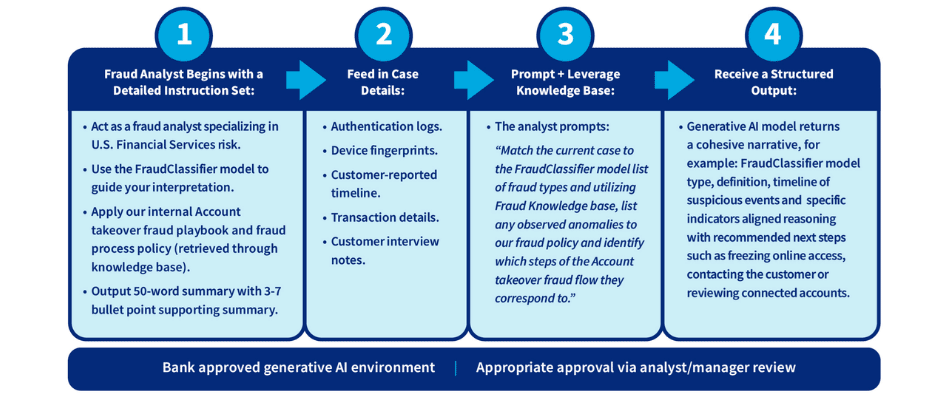
Use Case 1: Reviewing an Account Takeover Fraud Case
Account takeover fraud cases often involve subtle or fragmented data: shifts in device behavior, credential resets or unexplained logins. The FraudClassifier model reinforces a structured way of approaching these events, focusing on who initiated the activity and how the unauthorized access was executed. Below is an example of how an analyst may use generative AI, context instructions and a knowledge base to review a case.
Use Case 2: Reviewing a Scam Driven Authorized Payment
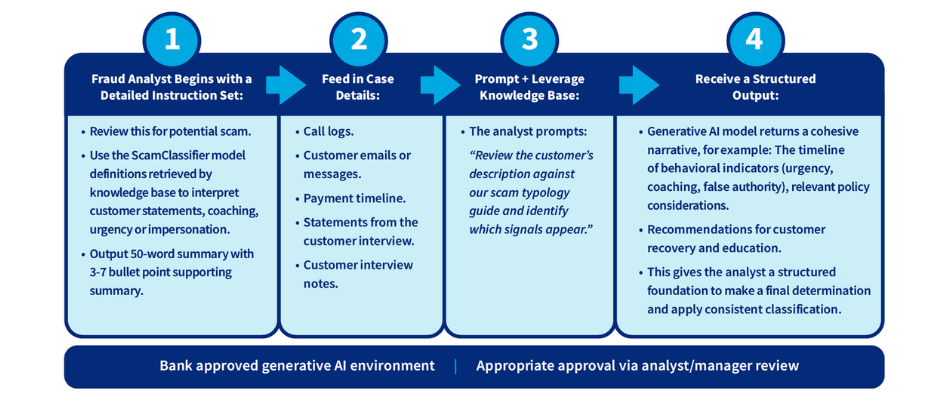
Authorized payments resulting from scams are difficult fraud cases to manage, because the customer initiates the transaction even though manipulation led to the decision. The ScamClassifier model helps identify the scam type and root cause, while the other data points provide additional context about related unauthorized activity.
Below are sample context instructions for a scenario from fraud case files where a consumer was deceived into sending funds under false pretenses.
The Human-AI Partnership in Fraud Review
As powerful as generative AI has become, the analyst needs to remain at the center of every review and every resulting decision. The role of AI is to strengthen the analyst’s work, not replace their judgment. Generative AI can rapidly organize case information; reference internal policies through knowledge base, surface indicators tied to the FraudClassifier and ScamClassifier models; and present consistent reasoning that reduces the risk of mistakes. But analysts bring context that AI cannot replicate: an understanding of customer behavior, nuances in communication styles, historical case patterns and the professional skepticism that only comes with experience. Generative AI accelerates work; the analyst points toward the right outcome. This collaboration creates a review process that may not only be more efficient, but also may be more consistent, defendable and aligned with industry-defined fraud structures.
Final Thoughts
Fraud analysis has always demanded quick thinking, careful judgment and a structured understanding of how fraud and scam driven events unfold. The introduction of generative AI doesn’t change that requirement; it amplifies the analyst’s ability to meet it. When generative AI is guided by strong context instructions and grounded in internal policy knowledge bases and in the shared industry language provided by the FraudClassifier and ScamClassifier models, it becomes a reliable partner rather than a general-purpose tool. It helps analysts navigate complex and sometimes chaotic case information, highlights what matters most, and provides a consistent framework for classification and decision-making. Generative AI is exciting and new, but outputs must be carefully tested and reviewed to ensure they meet expectations. Testing and human review will continue to be crucial. Analysts should not be discouraged by results that fall short. Instead, they should treat these moments as opportunities to refine how they are using the technology.
As fraud continues to evolve, the organizations that thrive may be those that combine the speed and structure of generative AI with the informed judgment of skilled analysts. Together, this partnership strengthens defenses, supports industry-aligned practices, and enhances the clarity and confidence of fraud reviews.